This is a viewer only at the moment see the article on how this works.
To update the preview hit Ctrl-Alt-R (or ⌘-Alt-R on Mac) or Enter to refresh. The Save icon lets you save the markdown file to disk
This is a preview from the server running through my markdig pipeline
Wednesday, 05 November 2025
OPMERKING: Dit artikel is voornamelijk AI gegenereerd als onderdeel van mijn nuget pakket als release documentatie.
Inleiding
Heb je ooit een API moeten testen die nog niet klaar was?


Geen configuratiebestanden.Geen handmatige eindpuntcreatie.Richt het gewoon op een OpenAPI spec en begin met het maken van verzoeken.
U kunt de
graph TD
    A[Your App] --> B{External API}
    B -->|Not Ready| C[Development Blocked]
    B -->|Rate Limited| D[Can't Test Freely]
    B -->|Requires Auth| E[Complex Setup]
    B -->|Expensive| F[Cost Concerns]
    B -->|Unreliable| G[Flaky Tests]
GitHub hier
Tijdens de ontwikkeling wordt u geconfronteerd met verschillende uitdagingen:
sequenceDiagram
    participant Dev as Developer
    participant System as Mock System
    participant Spec as OpenAPI Spec
    participant LLM as Local LLM

    Dev->>System: Load spec from URL/file
    System->>Spec: Parse OpenAPI document
    Spec-->>System: Endpoints, schemas, descriptions
    System->>System: Register dynamic routes

    Dev->>System: GET /petstore/pet/123
    System->>LLM: Generate data for "Pet" schema
    LLM-->>System: Realistic pet data
    System-->>Dev: {"id": 123, "name": "Max", ...}
Ontleedt de specificatie
graph TB
    A[HTTP Request] --> B{Route Matches?}
    B -->|No| C[404 Not Found]
    B -->|Yes| D[DynamicOpenApiManager]
    D --> E[Find Matching Endpoint]
    E --> F[OpenApiRequestHandler]
    F --> G[Extract Schema from Spec]
    G --> H[Build LLM Prompt]
    H --> I[PromptBuilder]
    I --> J[Include Context?]
    J -->|Yes| K[OpenApiContextManager]
    J -->|No| L[LLM Client]
    K --> L
    L --> M[Get Response]
    M --> N[JsonExtractor]
    N --> O[Return Mock Data]
Ontdekt alle eindpunten
PromptBuilder
POST /api/openapi/specs
Content-Type: application/json

{
  "name": "petstore",
  "source": "https://petstore3.swagger.io/api/v3/openapi.json",
  "basePath": "/petstore"
}
- Maakt LLM-prompts aan van OpenAPI schema's
POST /api/openapi/specs
Content-Type: application/json

{
  "name": "my-api",
  "source": "./specs/my-api.yaml",
  "basePath": "/api/v1"
}
OpenApiContextManager
POST /api/openapi/specs
Content-Type: application/json

{
  "name": "inline-api",
  "source": "data:application/json;base64,eyJvcGVuYXBpIjoiMy...",
  "basePath": "/api"
}
Specificaties laden
public async Task<SpecLoadResult> LoadSpecAsync(
    string name,
    string source,
    string? basePath = null,
    string? contextName = null)
{
    // 1. Use scoped service factory for OpenApiSpecLoader
    using var scope = _scopeFactory.CreateScope();
    var specLoader = scope.ServiceProvider
        .GetRequiredService<OpenApiSpecLoader>();

    // 2. Load the OpenAPI document
    var document = await specLoader.LoadSpecAsync(source);

    // 3. Determine base path from spec or parameter
    var effectiveBasePath = basePath
        ?? document.Servers?.FirstOrDefault()?.Url
        ?? "/api";

    // 4. Store spec with configuration
    var config = new OpenApiSpecConfig
    {
        Name = name,
        Source = source,
        Document = document,
        BasePath = effectiveBasePath,
        ContextName = contextName,
        LoadedAt = DateTimeOffset.UtcNow
    };

    _specs.AddOrUpdate(name, config, (_, __) => config);

    // 5. Notify listeners via SignalR
    await NotifySpecLoaded(name, effectiveBasePath);

    return new SpecLoadResult
    {
        Name = name,
        BasePath = effectiveBasePath,
        EndpointCount = CountEndpoints(document),
        Success = true
    };
}
public OpenApiEndpointMatch? FindMatchingEndpoint(string path, string method)
{
    // Try each loaded spec
    foreach (var spec in _specs.Values)
    {
        // Remove base path prefix
        var relativePath = path;
        if (path.StartsWith(spec.BasePath))
        {
            relativePath = path.Substring(spec.BasePath.Length);
        }

        // Find matching path in OpenAPI document
        var (pathTemplate, operation) = FindOperation(
            spec.Document,
            relativePath,
            method);

        if (operation != null)
        {
            return new OpenApiEndpointMatch
            {
                Spec = spec,
                PathTemplate = pathTemplate,
                Operation = operation,
                Method = ParseMethod(method)
            };
        }
    }

    return null;
}
public async Task<string> HandleRequestAsync(
    HttpContext context,
    OpenApiDocument document,
    string path,
    OperationType method,
    OpenApiOperation operation,
    string? contextName = null,
    CancellationToken cancellationToken = default)
{
    // 1. Extract request body
    var requestBody = await ReadRequestBodyAsync(context.Request);

    // 2. Get success response schema
    var shape = ExtractResponseSchema(operation);

    // 3. Get context history if using contexts
    var contextHistory = !string.IsNullOrWhiteSpace(contextName)
        ? _contextManager.GetContextForPrompt(contextName)
        : null;

    // 4. Build prompt from OpenAPI metadata
    var description = operation.Summary ?? operation.Description;
    var prompt = _promptBuilder.BuildPrompt(
        method.ToString(),
        path,
        requestBody,
        new ShapeInfo { Shape = shape },
        streaming: false,
        description: description,
        contextHistory: contextHistory);

    // 5. Get response from LLM
    var rawResponse = await _llmClient.GetCompletionAsync(
        prompt,
        cancellationToken);

    // 6. Extract clean JSON
    var jsonResponse = JsonExtractor.ExtractJson(rawResponse);

    // 7. Store in context if configured
    if (!string.IsNullOrWhiteSpace(contextName))
    {
        _contextManager.AddToContext(
            contextName,
            method.ToString(),
            path,
            requestBody,
            jsonResponse);
    }

    return jsonResponse;
}
private string? ExtractResponseSchema(OpenApiOperation operation)
{
    // Look for successful response (2xx)
    var successResponse = operation.Responses
        .FirstOrDefault(r => r.Key.StartsWith("2"))
        .Value;

    if (successResponse == null)
        return null;

    // Get JSON content
    var jsonContent = successResponse.Content
        .FirstOrDefault(c => c.Key.Contains("json"))
        .Value;

    if (jsonContent?.Schema == null)
        return null;

    // Convert OpenAPI schema to JSON Schema
    return ConvertToJsonSchema(jsonContent.Schema);
}

private string ConvertToJsonSchema(OpenApiSchema schema)
{
    // Recursively build JSON Schema representation
    var builder = new StringBuilder();
    builder.Append("{");

    if (schema.Type != null)
    {
        builder.Append($"\"type\":\"{schema.Type}\"");
    }

    if (schema.Properties?.Count > 0)
    {
        builder.Append(",\"properties\":{");
        var props = schema.Properties
            .Select(p => $"\"{p.Key}\":{ConvertToJsonSchema(p.Value)}");
        builder.Append(string.Join(",", props));
        builder.Append("}");
    }

    if (schema.Items != null)
    {
        builder.Append(",\"items\":");
        builder.Append(ConvertToJsonSchema(schema.Items));
    }

    builder.Append("}");
    return builder.ToString();
}
Dit is wat er gebeurt als je een spec laadt:
Dynamic Route Matching
POST /api/openapi/specs
Content-Type: application/json

{
  "name": "petstore",
  "source": "https://petstore3.swagger.io/api/v3/openapi.json",
  "basePath": "/petstore"
}
Wanneer een verzoek arriveert, komt het systeem overeen met alle geladen specificaties:
{
  "name": "petstore",
  "basePath": "/petstore",
  "endpointCount": 19,
  "endpoints": [
    {"path": "/petstore/pet", "method": "POST"},
    {"path": "/petstore/pet/{petId}", "method": "GET"},
    {"path": "/petstore/pet/findByStatus", "method": "GET"},
    ...
  ],
  "success": true
}
Behandeling van verzoeken
Zodra een passend eindpunt is gevonden, genereert de begeleider een respons:
### Get a pet by ID
GET /petstore/pet/123

### Response (auto-generated):
{
  "id": 123,
  "name": "Max",
  "category": {
    "id": 1,
    "name": "Dogs"
  },
  "photoUrls": [
    "https://example.com/max1.jpg"
  ],
  "tags": [
    {"id": 1, "name": "friendly"},
    {"id": 2, "name": "trained"}
  ],
  "status": "available"
}
### Find pets by status
GET /petstore/pet/findByStatus?status=available

### Response (auto-generated array):
[
  {
    "id": 42,
    "name": "Buddy",
    "status": "available",
    ...
  },
  {
    "id": 43,
    "name": "Luna",
    "status": "available",
    ...
  }
]
Schema extractie
GET /api/openapi/specs/petstore

### Shows full details:
### - All endpoints
### - Load time
### - Context configuration
### - Base path
Het systeem haalt responsschema's uit OpenAPI definities:
POST /api/openapi/specs/petstore/reload
Gebruik in de reële wereld
DELETE /api/openapi/specs/petstore
Laten we de klassieke Petstore API bespotten:
### Load Petstore at /petstore
POST /api/openapi/specs
{"name": "petstore", "source": "...", "basePath": "/petstore"}

### Load GitHub API at /github
POST /api/openapi/specs
{"name": "github", "source": "...", "basePath": "/github"}

### Load Stripe API at /stripe
POST /api/openapi/specs
{"name": "stripe", "source": "...", "basePath": "/stripe"}

### All three APIs now available simultaneously:
GET /petstore/pet/123
GET /github/users/octocat
GET /stripe/customers/cus_123
Respons:
POST /api/openapi/specs
Content-Type: application/json

{
  "name": "petstore",
  "source": "https://petstore3.swagger.io/api/v3/openapi.json",
  "basePath": "/petstore",
  "contextName": "petstore-session"
}
Stap 2: Gebruik de eindpunten van Mock
### Create a pet
POST /petstore/pet
{"name": "Max", "status": "available"}

### Response: {"id": 42, "name": "Max", "status": "available"}

### Get the pet (will reference same ID and name)
GET /petstore/pet/42

### Response: {"id": 42, "name": "Max", "status": "available"}
### Notice: Consistent ID and name from context
Stap 3: Inspecteer de spec
POST /api/openapi/test
Content-Type: application/json

{
  "specName": "petstore",
  "path": "/pet/123",
  "method": "GET"
}

### Returns mock response without affecting routes
Stap 4: Herladen als spec verandert
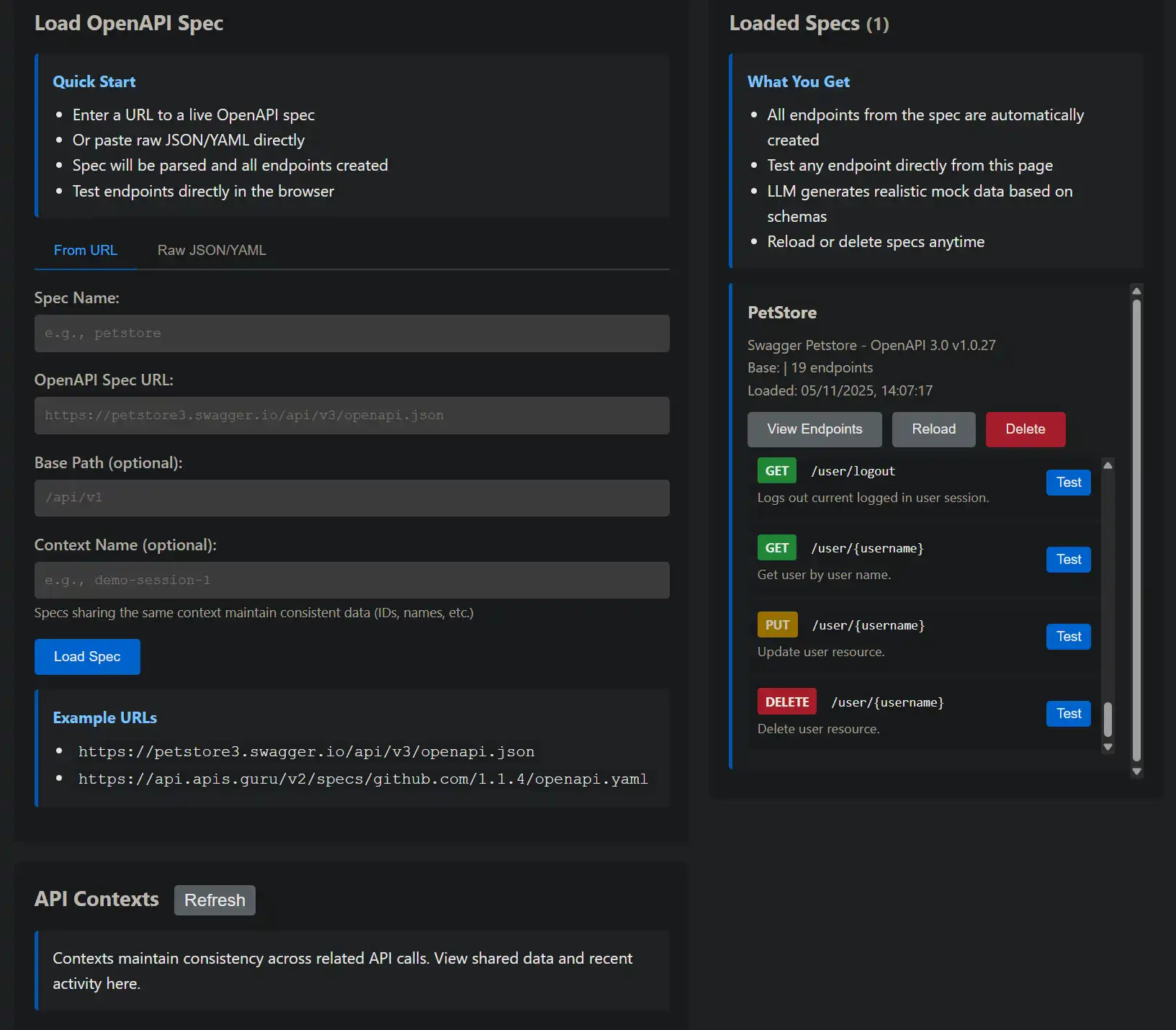
Voor nog meer realisme, geef een context aan een spec:http://localhost:5116/OpenApi:
graph TD
    A[OpenAPI Manager UI] --> B[Load Spec Section]
    A --> C[Spec List]
    A --> D[Context Viewer]

    B --> E[URL Input]
    B --> F[JSON Input]
    B --> G[Context Configuration]

    C --> H[Spec Card]
    H --> I[Reload Button]
    H --> J[Delete Button]
    H --> K[View Endpoints]

    D --> L[Active Contexts]
    L --> M[Context Details]
    L --> N[Clear Context]
Nu hebben alle petstore eindpunten dezelfde context:
# OpenAPI Spec
/pet/{petId}:
  get:
    parameters:
      - name: petId
        in: path
        schema:
          type: integer
GET /petstore/pet/123
### LLM receives: "Generate data for Pet with petId=123"
### Response: {"id": 123, ...}
/pet/findByStatus:
  get:
    parameters:
      - name: status
        in: query
        schema:
          type: string
          enum: [available, pending, sold]
GET /petstore/pet/findByStatus?status=available
### LLM receives: "Generate array of Pets with status=available"
### Response: [{"status": "available", ...}, ...]
/pet:
  post:
    requestBody:
      content:
        application/json:
          schema:
            $ref: '#/components/schemas/Pet'
POST /petstore/pet
Content-Type: application/json

{"name": "Max", "status": "available"}

### LLM receives: "Generate response for creating Pet with name=Max, status=available"
### Response: {"id": 42, "name": "Max", "status": "available"}
/pet/{petId}:
  get:
    summary: Find pet by ID
    description: Returns a single pet based on the ID provided
Geavanceerde functies
Padparameters worden automatisch uitgepakt:
responses:
  '200':
    description: Successful operation
    content:
      application/json:
        schema:
          $ref: '#/components/schemas/Pet'
  '404':
    description: Pet not found
Parameters opvragen
Verzoekorganen
public async Task NotifySpecLoaded(string name, string basePath)
{
    await _hubContext.Clients.All.SendAsync("SpecLoaded", new
    {
        name,
        basePath,
        timestamp = DateTimeOffset.UtcNow
    });
}

public async Task NotifySpecDeleted(string name)
{
    await _hubContext.Clients.All.SendAsync("SpecDeleted", new
    {
        name,
        timestamp = DateTimeOffset.UtcNow
    });
}
POST/PUT-lichamen zijn opgenomen in de prompt:
const connection = new signalR.HubConnectionBuilder()
    .withUrl('/hubs/openapi')
    .build();

connection.on('SpecLoaded', (data) => {
    showNotification(`Spec "${data.name}" loaded at ${data.basePath}`, 'success');
    refreshSpecList();
});

connection.on('SpecDeleted', (data) => {
    showNotification(`Spec "${data.name}" deleted`, 'info');
    refreshSpecList();
});
OpenAPI beschrijvingen begeleiden de LLM:
Wanneer specs worden geladen/verwijderd, ontvangt de UI real-time meldingen via SignalR:
 Bad:  {"name": "spec1", ...}
 Good: {"name": "github-v3", ...}
OpenAPI 3.0.x
### Good separation
/petstore/...
/github/...
/stripe/...

### Bad (conflicts!)
/api/... (multiple specs)
Swagger 2.0
POST /api/openapi/specs/my-api/reload
POST /api/openapi/specs
{
  "name": "petstore",
  "source": "...",
  "contextName": "test-session"
}

### Now all petstore calls maintain consistency
Zowel JSON als YAML specs worden automatisch gedetecteerd en ontleed.
DELETE /api/openapi/specs/old-spec
Opruimen na het testen/api/mockVerwijder specificaties die u niet meer gebruikt:
### OpenAPI-based (from spec)
GET /petstore/pet/123
### Uses Pet schema from OpenAPI spec

### Regular mock (shape-based)
GET /api/mock/custom?shape={"id":0,"name":"string"}
### Uses explicit shape parameter
Beperkingen
Authenticatie
private readonly ConcurrentDictionary<string, OpenApiSpecConfig> _specs = new();
DynamicOpenApiManagerValidatie
Staat
### Send these simultaneously
POST /api/openapi/specs {"name": "spec1", ...}
POST /api/openapi/specs {"name": "spec2", ...}
POST /api/openapi/specs {"name": "spec3", ...}
Integratie met reguliere Mock-eindpuntenOpenAPI-specs werken naast reguliere
eindpunten:
**is een singleton, dus specs blijven geladen voor de levensduur van de toepassing.**Parallelle spec laden
Meerdere specificaties kunnen parallel worden geladen:
/petstore + /pet/123 = /petstore/pet/123Spec laden misluktOplossingen:
Controleer of de URL toegankelijk is
Probleem:
404 bij verwacht eindpunt
Onthoud: LLM-generatie is probabilistisch, niet deterministisch
Conclusie

© 2026 Scott Galloway — Unlicense — All content and source code on this site is free to use, copy, modify, and sell.
