


Una implementación FastAPI que copia exactamente la API de EasyNMT (https://github.com/UKPLab/EasyNMT) un excelente pero abandonado proyecto de traducción de máquinas neuronales.
Pero he añadido MUCHAS características agradables para aumentar la fiabilidad y hacer que esté listo para su uso en un sistema de producción.Piensa en una traducción rápida.).
Desde el comienzo de este blog, una gran pasión ha sido la traducción automática de artículos de blog.
SÍ Sé que 'google hace esto' en los navegadores etc...etc...pero ese no es el punto.mostlylucid-nmt¡Quería saber CÓMO hacerlo!
Además, es agradable dar la bienvenida a las personas que no leen inglés (incluso si leen inglés como segundo idioma, es FAR más difícil de analizar).Así que descubrí cómo hacerlo; así como compartir cómo construir este tipo de sistema.Oh y me dio ideas sobre cómo usarlo en ASP.NET para la localización automática de texto (incluyendo texto dinámico) usando SignalR y un sistema de actualización en tiempo real. (
¡Manténganse atentosEsencialmente; los humanos escriben texto basura que es SUPER ruidoso para que las máquinas puedan manejar eficientemente.
Así que mucho fue averiguar cómo trabajar en torno a los problemas con EasyNMT (fue realmente un proyecto de investigación).


Iescribió todo un sistemahttp://<server>:<port>/demopara hacer que eso suceda con un proyecto increíble llamado EasyNMT.
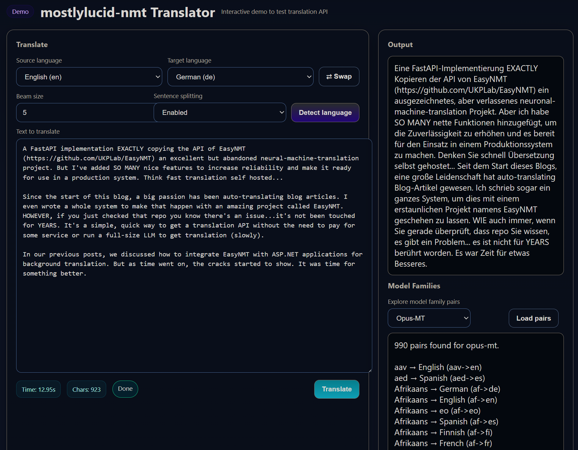
Es una manera sencilla y rápida de obtener una API de traducción sin la necesidad de pagar algún servicio o ejecutar un LLM de tamaño completo para obtener la traducción (lento).
**Pero a medida que pasaba el tiempo, las grietas empezaban a mostrarse.**Era hora de algo mejor.
**Como siempre está todo en GitHub y todo gratis para su uso, etc...**Tirador de muelles
Reusing loaded model for en->de (3/10 models in cache)Need to load model for en->fr (3/10 models in cache)Actualizaciones importantes (v3.1) - Inteligencia y visibilidadNuevo en v3.1:
====================================================================================================
  🚀 DOWNLOADING MODEL
  Model: facebook/mbart-large-50-many-to-many-mmt
  Family: mbart50
  Direction: en → bn
  Device: GPU (cuda:0)
  Total Size: 2.46 GB
  Files: 6 main files
====================================================================================================
[Progress bars for each file...]
====================================================================================================
  ✅ MODEL READY
  Model: facebook/mbart-large-50-many-to-many-mmt
  Translation: en → bn is now available
====================================================================================================
**: Tamaño de caché predeterminado alcanzado a 10 modelos (a partir de 6)**Registro del dispositivo por modelo
[Pivot] Languages reachable from en: 85 languages
[Pivot] Languages that can reach bn: 42 languages
[Pivot] Found 38 possible pivot languages
[Pivot] Selected pivot: en → hi → bn (both legs verified)
: Muestra el dispositivo de destino (GPU/CPU) en el bannerBarras de progreso
Request: en→bn with opus-mt
Trying families: ['opus-mt', 'mbart50', 'm2m100']  ✓ All three!
opus-mt: Failed (model doesn't exist)
mbart50: Success! (auto-fallback worked)
Selección inteligente de pivotes impulsada por datos- No más intentos ciegos:
Loading mbart50 model on GPU (cuda:0)Model loaded on device: cuda:0Successfully loaded... on GPU (cuda:0): No intentará en→es→bn si es→bn no existeEjemplo para en→bn
en->hi, hi->bn[Pivot] Both legs loaded and cached. Ready to translate.: Vea exactamente por qué cada pivote fue elegido o omitido4.
model_familySiempre trata de retrocesos: No más reintentar el mismo modelo dos vecesFlujo de ejemplo
**El mensaje de éxito incluye:**6.
**- Ya trabaja en demo:**Demo desplegable permite seleccionar opus-mt, mbart50, o m2m100
requirements-prod.txtPágina de demostración mejorada**- Interfaz interactiva preparada para la producción:**Diseño completo de la vista (100vw/100vh) para la experiencia de traducción inmersiva
**: FP16 activado, BATCH_SIZE=64, MAX_INFLIGHT=1 (óptimo para una sola GPU)**CPU
**- Imágenes más pequeñas y rápidas:**Dependencias de prueba eliminadas (pytest, pytest-cov) de las construcciones de producción
Pruebas completas y pruebas de carga- Validar todo:
con pautas de tráfico realistasScripts de validación multiplataforma
/discover/opus-mt(PowerShell + Bash)/discover/mbart50Pruebas para descargas de modelos y copia de seguridad de la traducción de pivotes/discover/m2m100Pruebas automatizadas de humo para una validación rápida**5.**Documentación de despliegue
Manifiestos de Kubernetes con PVC, límites de recursos, chequeos médicosEjemplos de casos de contenedores de Azure
scottgal/mostlylucid-nmt:cpuOrientación sobre las pruebas de carga y recomendaciones de supervisión:latestExplicación de las compensaciones entre divisas y rendimientosscottgal/mostlylucid-nmt:cpu-min6.scottgal/mostlylucid-nmt:gpuTres familias modeloscottgal/mostlylucid-nmt:gpu-min- Elija lo mejor para sus necesidades:Opus-MT: 1200+ pares, la mejor calidad (modelos separados)
latest, min, gpu, gpu-min: 50 idiomas, modelo único 2.4GB, 2.450 pares20250108.143022: 100 idiomas, modelo único 2.2GB, 9.900 paresAuto-caída- Selecciona inteligentemente el mejor modelo disponible:
- Todos los pares mBART50- Todos los pares M2M100
No hay modelos precargados (descargar bajo demanda)
Cambiar familias modelo sin reconstrucción**10.**Repositorio de un solo Docker
cpu(olatest) | scottgal/mostlylucid-nmt:cpu) - CPU
| cpu-min | scottgal/mostlylucid-nmt:cpu-min- CPU mínima
| gpu | scottgal/mostlylucid-nmt:gpu- GPU con CUDA 12,6
| gpu-min | scottgal/mostlylucid-nmt:gpu-min- GPU mínima**11.**Versión adecuada
Etiquetas completas de OCI para el seguimiento de versiones, fechas de compilación y git commits
docker run -d \
  --name mostlylucid-nmt \
  -p 8000:8000 \
  scottgal/mostlylucid-nmt
12.
curl -X POST "http://localhost:8000/translate" \
  -H "Content-Type: application/json" \
  -d '{
    "text": ["Hello, how are you?"],
    "target_lang": "de"
  }'
Últimas imágenes de base
{
  "translated": ["Hallo, wie geht es Ihnen?"],
  "target_lang": "de",
  "source_lang": "en",
  "translation_time": 0.34
}
Python 3,12-slim
docker run -d \
  --name mostlylucid-nmt \
  --gpus all \
  -p 8000:8000 \
  -e EASYNMT_MODEL_ARGS='{"torch_dtype":"fp16"}' \
  scottgal/mostlylucid-nmt:gpu
CUDA 12,6
con Ubuntu 24.04 para imágenes GPU (última pila NVIDIA)
docker run -d \
  --name mostlylucid-nmt \
  -p 8000:8000 \
  -v $HOME/model-cache:/models \
  -e MODEL_CACHE_DIR=/models \
  scottgal/mostlylucid-nmt:cpu-min
PyTorch con CUDA 12.4
docker run -d `
  --name mostlylucid-nmt `
  -p 8000:8000 `
  -v ${HOME}/model-cache:/models `
  -e MODEL_CACHE_DIR=/models `
  scottgal/mostlylucid-nmt:cpu-min
(compatible con el tiempo de ejecución de CUDA 12,6)
docker run -d ^
  --name mostlylucid-nmt ^
  -p 8000:8000 ^
  -v %USERPROFILE%/model-cache:/models ^
  -e MODEL_CACHE_DIR=/models ^
  scottgal/mostlylucid-nmt:cpu-min
Todas las dependencias actualizadas a las últimas versiones seguras
13.
curl http://localhost:8000/healthz
Advertencias de depredación fijas
Transformers_CACHE eliminados obsoletos (ahora utilizando HF_HOME)Compatible con Transformers v5Inicio rápido (5 minutos)
http://localhost:8000/demo/
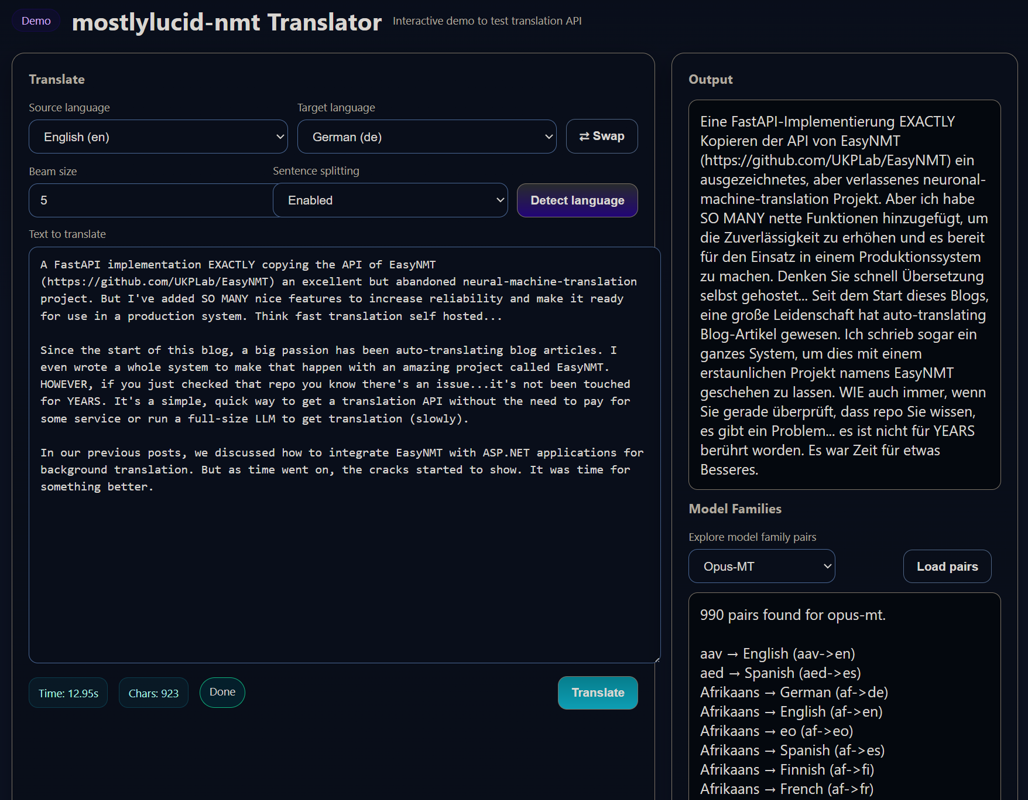
Esta es la forma más simple de ejecutar mayoritariamente lucid-nmt:
Imágenes Docker disponibles
Tag Nombre completo de la imagen Tamaño Descripción Caso de uso
Imágenes mínimas
Mantener el tamaño del envase pequeño
Requiere tiempo de ejecución NVIDIA Docker:
Chequeo médico:
// Example: Translating a 5000-word article
Input: Long article with multiple paragraphs

Step 1: Split by paragraphs (preserves structure)
  → Paragraph 1 (800 chars)
  → Paragraph 2 (1200 chars)
  → Paragraph 3 (600 chars)
  ...

Step 2: Group into ~1000 character chunks
  → Chunk 1: Paragraphs 1-2
  → Chunk 2: Paragraph 3-4
  → Chunk 3: Paragraphs 5-6

Step 3: Translate each chunk sequentially
  → Shows progress: "Translating chunk 1/3..."
  → Shows progress: "Translating chunk 2/3..."
  → Shows progress: "Translating chunk 3/3..."

Step 4: Reassemble with paragraph breaks
  → Final output: Complete translated article with preserved formatting
Auto-poblado lenguaje desplegables desde el servicio en vivo
Maneja automáticamente entradas de texto grandes de cualquier tamaño
3.
Opciones avanzadas:
Dividir la sentencia:
Estadísticas en tiempo real:
: Inactivo → Traducción → Hecho/Error
: 100 idiomas, 9.900 pares/demo/Vea exactamente qué pares de idiomas están disponibles antes de traducir
La demo implementa texto inteligente troceado en el lado del cliente:¿ Por qué usar la demostración?Pruebas rápidasProbar traducciones sin escribir códigoValidar la disponibilidad del par de idiomas
Comparar calidad de traducción con diferentes tamaños de haz
Pegar la entrada completa del blog (5000+ palabras)Demo automáticamente lo divide en piezas manejablesMuestra el progreso mientras cada trozo se traduce
Detección de idiomasPegar texto en un idioma desconocidoHaga clic en "Detectar idioma"
**No hay contrapresión ni cola.**Envía demasiadas peticiones y se acaba.MODEL_FAMILYNo hay observabilidad.
# Opus-MT (default, best quality)
MODEL_FAMILY=opus-mt

# mBART50 (50 languages, single model)
MODEL_FAMILY=mbart50

# M2M100 (100 languages, broadest coverage)
MODEL_FAMILY=m2m100
La solución: Mayormente Lucid-NMTAsí que... decidí construir una nueva y mejorada EasyNMT, ahoraprincipalmente lucid-nmt
MODEL_FAMILYEsto es lo que lo hace mejor:opus-mtApoyo a la familia multimodeloOpus-MT (Helsinki-NLP) - Predeterminado
# Set primary to Opus-MT (best quality)
MODEL_FAMILY=opus-mt
AUTO_MODEL_FALLBACK=1
MODEL_FALLBACK_ORDER=opus-mt,mbart50,m2m100

# Request Ukrainian → French
# 1. Try Opus-MT first (not available)
# 2. Automatically fall back to mBART50 (available!)
# 3. Translation succeeds with mBART50
Cobertura:
300-500MB por dirección
# Enable auto-fallback (default: enabled)
AUTO_MODEL_FALLBACK=1

# Set fallback priority (default: opus-mt → mbart50 → m2m100)
MODEL_FALLBACK_ORDER="opus-mt,mbart50,m2m100"

# Disable for strict single-family mode
AUTO_MODEL_FALLBACK=0
Ejemplo
-minTamaño del modelo:Ventaja:
Cambiar es fácil.
Una de las nuevas características más poderosas es
**Cómo funciona:**Usted establece un primario
Prestaciones:
Soporta más de 100 idiomas sin administrar múltiples implementaciones
Registro transparente:
Apoyo a la familia multimodelo
# NMT: Fits on a USB stick
du -sh model-cache/
2.5G    model-cache/

# LLM: Needs serious storage
du -sh llama-models/
140G    llama-models/
Parámetros de descubrimiento de modelos
¿Símbolos?
Caché modelo LRU
API compatible con EasyNMT
variantes con caché con mapas de volumen para implementaciones más pequeñas.
¿Por qué NMT sobre LLMs para la traducción?
Input: "The API returns a 429 status code when rate limited."

NMT (Opus-MT): "Die API gibt einen 429-Statuscode zurück, wenn sie ratenbegrenzt ist."
(Accurate, preserves technical terms)

LLM (might do): "Die API sendet den Fehlercode 429, wenn zu viele Anfragen gestellt werden."
(Interprets rather than translates, adds context not in original)
Aquí está la comprobación de la realidad basada en el uso de la producción:
GPT-4: 3-10 segundos por solicitud (latencia API + generación)
API GPT-4**: 30-60 segundos**Llama local 70B
Opus-MT (por dirección): 300-500MB
mBART50 (los 50 idiomas): 2,4GBM2M100 (los 100 idiomas): 2,2GB
flowchart LR
    A[HTTP Client] --> B[API Gateway]
    B --> C[Translation Endpoint]
    C --> D{Has Capacity?}
    D -->|Yes| E[Translation Service]
    D -->|No| F[Queue with 429]
    F --> E
    E --> G[Process Pipeline]
    G --> H[Get Model from Cache]
    H --> I[Translate]
    I --> J[Return Response]
    J --> A
LLMs:
Retry-AfterCosto: $10-20 por mes VPS**Puntos fuertes de la NMT:**Formado específicamente para la traducciónRetry-AfterCalidad consistente (misma entrada = misma salida)
No se necesita ingeniería rápida
sequenceDiagram
    participant Client
    participant API
    participant Queue
    participant Translator
    participant Cache
    participant Model

    Client->>API: POST /translate
    API->>Queue: Acquire slot

    alt Queue has space
        Queue-->>API: Slot acquired
        API->>Translator: Process translation
        Translator->>Translator: Sanitize input
        Translator->>Translator: Split sentences
        Translator->>Translator: Chunk text
        Translator->>Translator: Mask symbols
        Translator->>Cache: Get model (en→de)

        alt Cache hit
            Cache-->>Translator: Return cached model
        else Cache miss
            Cache->>Model: Load from Hugging Face
            Model-->>Cache: Pipeline loaded
            Cache->>Cache: Evict old if at capacity
            Cache-->>Translator: Return model
        end

        Translator->>Model: Translate batches
        Model-->>Translator: Translations
        Translator->>Translator: Unmask symbols
        Translator->>Translator: Post-process
        Translator-->>API: Translations
        API->>Queue: Release slot
        API-->>Client: 200 OK + translations
    else Queue full
        Queue-->>API: Overflow error
        API-->>Client: 429 Too Many Requests\nRetry-After: X seconds
    end
Escenario de ejemplo:
graph LR
    A[Raw Input] --> B{Sanitize?}
    B -->|Yes| C[Check Noise]
    B -->|No| D[Split Sentences]
    C -->|Is Noise| Z[Return Placeholder]
    C -->|Valid| D

    D --> E[Enforce Max Length]
    E --> F[Chunk for Batching]
    F --> G{Symbol Masking?}

    G -->|Yes| H[Mask Digits/Punct/Emoji]
    G -->|No| I[Translate]
    H --> I

    I --> J{Direct Model?}
    J -->|Available| K[Direct Translation]
    J -->|Not Available| L{Pivot Fallback?}

    L -->|Yes| M[src→en→tgt]
    L -->|No| Z
    K --> N[Unmask Syis robust input handling. Here's what happens:

**Noise Detection:**
- Strips control characters (except \t, \n, \r)
- Checks minimum character count (default: 1)
- Calculates alphanumeric ratio (default: must be ≥20%)
- Rejects pure emoji, pure punctuation, or pure whitespace

**Symbol Masking:**
Why mask symbols? Translation models are trained on text, not emoji or special symbols. These can confuse them or get mangled. So we:

1. Extract all digits, punctuation, and emoji as contiguous runs
2. Replace them with sentinel tokens: `⟪MSK0⟫`, `⟪MSK1⟫`, etc.
3. Translate the masked text
4. Restore the original symbols in their positions

Example:
Input: "Hello 👋 world! Price: $99.99" Cuándo usar cada uno (👋) (!) (:) ($99.99)
**Post-Processing:**
After translation, we remove "symbol loops" - repeated symbols that weren't in the source:
Usar NMT (principalmente lúcido-nmt) cuando: Usted necesita una traducción consistente y rápida a escala Cuestiones presupuestarias (autoasentamiento o gran volumen)
### Sentence Splitting & Chunking

Long texts get split intelligently:

```mermaid
graph TD
    A[Long Text] --> B[Split on . ! ? …]
    B --> C{Sentence > 500 chars?}
    C -->|Yes| D[Split on word boundaries]
    C -->|No| E[Keep sentence]
    D --> E

    E --> F[Group into chunks ≤900 chars]
    F --> G[Translate each chunk]
    G --> H[Join with space]
Está traduciendo contenido técnico, código, datos estructurados
Necesitas adaptación creativa, no traducción literal.
stateDiagram-v2
    [*] --> CheckCache
    CheckCache --> CacheHit: Model exists
    CheckCache --> CacheMiss: Model not loaded

    CacheHit --> MoveToEnd: Update LRU order
    MoveToEnd --> ReturnModel

    CacheMiss --> CheckCapacity
    CheckCapacity --> LoadModel: Space available
    CheckCapacity --> EvictOldest: Cache full

    EvictOldest --> MoveToCPU: Free VRAM
    MoveToCPU --> ClearCUDA: torch.cuda.empty_cache()
    ClearCUDA --> LoadModel

    LoadModel --> AddToCache
    AddToCache --> ReturnModel
    ReturnModel --> [*]
El contexto y los matices culturales importan más que la velocidad
(mi caso de uso), NMT es el ganador claro:
# Semaphore limits concurrent translations
MAX_INFLIGHT = 1  # On GPU, 1 at a time for efficiency
MAX_QUEUE_SIZE = 1000  # Up to 1000 waiting

# When full:
# - Returns 429 Too Many Requests
# - Includes Retry-After header
# - Estimates wait time based on average duration
Traduce más de 100 entradas de blog a 12 idiomas en ~30 minutos (GPU)
avg_duration = 2.5 seconds (tracked with EMA)
waiters = 100
slots = 1
estimated_wait = (100 / 1) * 2.5 = 250 seconds
clamped = min(250, 120) = 120 seconds
Retry-After: 120
Calidad constante en todos los puestos
graph LR
    A[Ukrainian Text] --> B{Direct uk→fr?}
    B -->|Exists| C[Translate Directly]
    B -->|Missing| D[Pivot via English]

    D --> E[uk→en]
    E --> F[en→fr]
    F --> G[French Result]
    C --> G
Configuración total: Un contenedor Docker
La diferencia de velocidad por sí sola hace de NMT la única opción práctica para las tuberías de traducción de producción.
NMT está diseñado específicamente para la traducción, se ejecuta en hardware modesto, y es 10-100x más rápido que LLMs. Si necesita una traducción rápida, consistente y rentable a escala, NMT gana mano a mano.
# src/core/cache.py
from collections import OrderedDict
import torch

class LRUPipelineCache:
    """LRU cache that automatically cleans up GPU memory when evicting models."""

    def __init__(self, capacity: int):
        self.cache = OrderedDict()  # Maintains insertion order
        self.capacity = capacity

    def get(self, key: str):
        """Get model from cache, moves it to end (most recently used)."""
        if key not in self.cache:
            return None
        self.cache.move_to_end(key)  # Mark as recently used
        return self.cache[key]

    def put(self, key: str, value):
        """Add model to cache, evicting oldest if at capacity."""
        if key in self.cache:
            self.cache.move_to_end(key)
        else:
            self.cache[key] = value

        # If cache is full, evict the oldest model
        if len(self.cache) > self.capacity:
            oldest_key, oldest_pipeline = self.cache.popitem(last=False)

            # MAGIC: Move evicted model to CPU to free GPU memory
            try:
                oldest_pipeline.model.to("cpu")
                if torch.cuda.is_available():
                    torch.cuda.empty_cache()  # Tell GPU to release memory
                logger.info(f"Evicted {oldest_key}, freed GPU memory")
            except Exception as e:
                logger.warning(f"Failed to clean GPU memory: {e}")
Descripción general de la arquitectura
OrderedDictEl flujo de petición es sencillo:→ Solicitud va al Servicio de Traducción inmediatamente
# src/services/model_manager.py
def get_pipeline(self, src: str, tgt: str):
    """Try to get translation model, with automatic fallback to other providers."""

    # Determine which model families support this language pair
    families_to_try = []

    if config.AUTO_MODEL_FALLBACK:
        # Try families in priority order: opus-mt → mbart50 → m2m100
        for family in config.MODEL_FALLBACK_ORDER.split(","):
            if self._is_pair_supported(src, tgt, family.strip()):
                families_to_try.append(family.strip())

    # Try each family until one succeeds
    last_error = None
    for family in families_to_try:
        try:
            model_name, src_lang, tgt_lang, _ = self._get_model_name_and_langs(src, tgt, family)

            if family != config.MODEL_FAMILY:
                logger.info(f"Using fallback '{family}' for {src}->{tgt}")

            # Load the model from HuggingFace
            pipeline = transformers.pipeline(
                "translation",
                model=model_name,
                device=device_manager.device_index,
                src_lang=src_lang,
                tgt_lang=tgt_lang
            )

            self.cache.put(f"{src}->{tgt}", pipeline)
            return pipeline

        except Exception as e:
            last_error = e
            logger.warning(f"Family '{family}' failed for {src}->{tgt}: {e}")
            continue  # Try next family

    # All families failed
    raise ModelLoadError(f"{src}->{tgt}", last_error)
No
(LRU) ofrece modelos de traducción:
# src/services/queue_manager.py
import asyncio
from contextlib import asynccontextmanager

class QueueManager:
    """Manages request queuing and backpressure."""

    def __init__(self, max_inflight: int, max_queue: int):
        self.semaphore = asyncio.Semaphore(max_inflight)  # Limit concurrent translations
        self.max_queue_size = max_queue
        self.waiting_count = 0
        self.inflight_count = 0
        self.avg_duration_sec = 5.0  # Exponential moving average

    @asynccontextmanager
    async def acquire_slot(self):
        """Try to get a translation slot, track metrics, handle queueing."""

        # Check if queue is too full
        if self.waiting_count >= self.max_queue_size:
            # Calculate how long client should wait before retrying
            retry_after = self._estimate_retry_after()
            raise QueueOverflowError(self.waiting_count, retry_after)

        self.waiting_count += 1
        try:
            # Wait for available slot (this is the queue!)
            await self.semaphore.acquire()
            self.waiting_count -= 1
            self.inflight_count += 1

            start_time = time.time()
            yield  # Let the translation happen

            # Update average duration for retry-after estimates
            duration = time.time() - start_time
            alpha = config.RETRY_AFTER_ALPHA  # Smoothing factor (0.2)
            self.avg_duration_sec = alpha * duration + (1 - alpha) * self.avg_duration_sec

        finally:
            self.inflight_count -= 1
            self.semaphore.release()

    def _estimate_retry_after(self) -> int:
        """Smart calculation: how many waiting / how many slots * avg time per request."""
        if self.inflight_count == 0:
            return config.RETRY_AFTER_MIN_SEC

        # If 10 people waiting and 2 slots available, and each takes 5 seconds:
        # retry_after = (10 / 2) * 5 = 25 seconds
        retry_sec = (self.waiting_count / self.semaphore._value) * self.avg_duration_sec

        # Clamp between min and max
        return max(
            config.RETRY_AFTER_MIN_SEC,
            min(int(retry_sec), config.RETRY_AFTER_MAX_SEC)
        )
Caché → Respuesta rápida
max_inflight)@asynccontextmanagerdevuelve al clienteTubería de procesamiento de entrada
# src/utils/symbol_masking.py
import re

def mask_symbols(text: str) -> tuple[str, dict[str, str]]:
    """Replace special symbols with placeholders before translation."""

    originals = {}
    masked_text = text
    placeholder_counter = 0

    # Pattern: Match emojis, symbols, special punctuation
    # \U0001F300-\U0001F9FF = emoji range
    # [\u2600-\u26FF\u2700-\u27BF] = misc symbols
    symbol_pattern = re.compile(
        r'[\U0001F300-\U0001F9FF\u2600-\u26FF\u2700-\u27BF'
        r'\u00A9\u00AE\u2122\u2139\u3030\u303D\u3297\u3299]+'
    )

    for match in symbol_pattern.finditer(text):
        symbol = match.group()
        placeholder = f"__SYMBOL_{placeholder_counter}__"
        originals[placeholder] = symbol
        masked_text = masked_text.replace(symbol, placeholder, 1)
        placeholder_counter += 1

    return masked_text, originals

def unmask_symbols(text: str, originals: dict[str, str]) -> str:
    """Restore original symbols after translation."""
    for placeholder, original in originals.items():
        text = text.replace(placeholder, original)
    return text
El servicio utiliza una sofisticada tubería multietapa para manejar texto desordenado del mundo real:
# Before translation:
text = "Hello! 👋 Check out this cool feature 🚀"

# Mask symbols:
masked, originals = mask_symbols(text)
# masked = "Hello! __SYMBOL_0__ Check out this cool feature __SYMBOL_1__"
# originals = {"__SYMBOL_0__": "👋", "__SYMBOL_1__": "🚀"}

# Translate the masked text:
translated = translate(masked, "de")  # → "Hallo! __SYMBOL_0__ Schau dir diese coole Funktion an __SYMBOL_1__"

# Unmask symbols:
final = unmask_symbols(translated, originals)
# final = "Hallo! 👋 Schau dir diese coole Funktion an 🚀"
Enmascarado: "Hello MSK0 worldMSK1 PriceMSK2 MSK3"
👋Los modelos no se ahogan con entradas enormes__SYMBOL_0__Podemos lote eficientementePor qué esto importa:
# src/utils/text_processing.py
def chunk_sentences(sentences: list[str], max_chars: int = 900) -> list[list[str]]:
    """Group sentences into chunks that fit within model's max input length."""

    chunks = []
    current_chunk = []
    current_length = 0

    for sentence in sentences:
        sentence_len = len(sentence)

        # If this sentence alone is too long, it goes in its own chunk
        if sentence_len > max_chars:
            if current_chunk:
                chunks.append(current_chunk)
                current_chunk = []
                current_length = 0
            chunks.append([sentence])
            continue

        # If adding this sentence exceeds limit, start new chunk
        if current_length + sentence_len + 1 > max_chars:
            chunks.append(current_chunk)
            current_chunk = [sentence]
            current_length = sentence_len
        else:
            current_chunk.append(sentence)
            current_length += sentence_len + 1  # +1 for space

    # Don't forget the last chunk!
    if current_chunk:
        chunks.append(current_chunk)

    return chunks

def split_sentences(text: str, max_sentence_chars: int = 500) -> list[str]:
    """Split text into sentences, enforcing max length."""

    # Split on common sentence terminators
    sentences = re.split(r'([.!?…]+\s+)', text)

    result = []
    for sentence in sentences:
        if not sentence or sentence.isspace():
            continue

        # If sentence is too long, split on word boundaries
        if len(sentence) > max_sentence_chars:
            words = sentence.split()
            current = []
            current_len = 0

            for word in words:
                if current_len + len(word) + 1 > max_sentence_chars:
                    result.append(' '.join(current))
                    current = [word]
                    current_len = len(word)
                else:
                    current.append(word)
                    current_len += len(word) + 1

            if current:
                result.append(' '.join(current))
        else:
            result.append(sentence.strip())

    return result
La memoria de la GPU es preciosa
.!?…Mantenemos los 6 modelos más recientes en calientePivot a través del inglés:
# src/services/model_discovery.py
import httpx
from datetime import datetime, timedelta

class ModelDiscoveryService:
    """Discovers available translation models with 1-hour cache."""

    def __init__(self):
        self._cache = {}  # Cache results to avoid hammering HuggingFace API
        self._cache_ttl = timedelta(hours=1)
        self._hf_api_base = "https://huggingface.co/api/models"

    async def discover_opus_mt_pairs(self, force_refresh: bool = False):
        """Query HuggingFace for all Helsinki-NLP Opus-MT models."""

        cache_key = "opus-mt"

        # Check cache first
        if not force_refresh and cache_key in self._cache:
            cached_data, cached_time = self._cache[cache_key]
            if datetime.now() - cached_time < self._cache_ttl:
                return cached_data  # Cache hit!

        # Cache miss - query HuggingFace API
        async with httpx.AsyncClient() as client:
            response = await client.get(
                self._hf_api_base,
                params={
                    "author": "Helsinki-NLP",
                    "search": "opus-mt",
                    "limit": 1000
                },
                timeout=30.0
            )
            models = response.json()

        # Extract language pairs from model names
        # Example: "Helsinki-NLP/opus-mt-en-de" → ("en", "de")
        pairs = []
        for model in models:
            model_id = model.get("modelId", "")
            if model_id.startswith("Helsinki-NLP/opus-mt-"):
                # Extract the language codes after "opus-mt-"
                lang_part = model_id.replace("Helsinki-NLP/opus-mt-", "")
                if "-" in lang_part:
                    src, tgt = lang_part.split("-", 1)
                    pairs.append({"source": src, "target": tgt})

        # Cache the results
        self._cache[cache_key] = (pairs, datetime.now())

        return pairs
Esto duplica la latencia, pero asegura la cobertura para todos los pares de idiomas soportados.
httpxVamos a explorar algunas de las partes más interesantes de la base de código!enUna de las características más geniales es la caché de modelo inteligente que sabe manejar la memoria GPU:de¿Qué está pasando aquí?Helsinki-NLP/opus-mt-en-deLimpieza de la GPU
# src/core/device.py
import torch

class DeviceManager:
    """Smart device selection with GPU auto-detection."""

    def __init__(self):
        self.use_gpu = self._should_use_gpu()
        self.device_index = self._resolve_device()
        self.device_str = "cpu" if self.device_index < 0 else f"cuda:{self.device_index}"

        # Auto-configure parallel translation slots based on device
        if self.device_index >= 0:
            # GPU: Run translations serially to avoid VRAM fragmentation
            self.max_inflight = 1
        else:
            # CPU: Can handle multiple translations in parallel
            self.max_inflight = config.MAX_WORKERS_BACKEND

        self._log_device_info()

    def _should_use_gpu(self) -> bool:
        """Check if GPU should be used."""
        if config.USE_GPU.lower() == "false":
            return False
        if config.USE_GPU.lower() == "true":
            return torch.cuda.is_available()
        # "auto" mode: use GPU if available
        return torch.cuda.is_available()

    def _resolve_device(self) -> int:
        """Returns device index: -1 for CPU, 0+ for CUDA."""
        if not self.use_gpu:
            return -1

        # Check if specific CUDA device requested
        if config.DEVICE and config.DEVICE.startswith("cuda:"):
            device_num = int(config.DEVICE.split(":")[1])
            return device_num

        return 0  # Use first GPU

    def _log_device_info(self):
        """Log device information at startup."""
        if self.device_index >= 0:
            gpu_name = torch.cuda.get_device_name(self.device_index)
            vram_gb = torch.cuda.get_device_properties(self.device_index).total_memory / 1e9
            logger.info(f"Using GPU: {gpu_name} ({vram_gb:.1f}GB VRAM)")
            logger.info(f"Max inflight translations: {self.max_inflight} (GPU mode)")
        else:
            cpu_count = os.cpu_count()
            logger.info(f"Using CPU ({cpu_count} cores)")
            logger.info(f"Max inflight translations: {self.max_inflight} (CPU mode)")

# Global singleton instance
device_manager = DeviceManager()
: Al desalojar un modelo, lo movemos explícitamente a la memoria de la CPU y le decimos a la GPU que libere sus recursos
max_inflight=1Esta característica inteligente intenta múltiples proveedores de modelos de IA automáticamente si el primero no tiene el par de idiomas que necesita:max_inflight=4¿Qué está pasando aquí?DEVICE=cuda:1: Los modelos exitosos se guardan en caché con la clave del par de idiomas
# Snippet from QueueManager showing EMA calculation
def update_avg_duration(self, new_duration: float):
    """Update average duration using exponential moving average."""

    # EMA formula: new_avg = α × new_value + (1 - α) × old_avg
    # α = smoothing factor (0.0 to 1.0)
    #   - Higher α = more weight to recent values (faster adaptation)
    #   - Lower α = more weight to historical values (more stable)

    alpha = 0.2  # 20% weight to new value, 80% to historical

    self.avg_duration_sec = (
        alpha * new_duration +
        (1 - alpha) * self.avg_duration_sec
    )
3.
# Initial average: 5.0 seconds
# New request takes: 10.0 seconds

# EMA calculation:
new_avg = 0.2 * 10.0 + 0.8 * 5.0
        = 2.0 + 4.0
        = 6.0 seconds

# Next request takes: 3.0 seconds
new_avg = 0.2 * 3.0 + 0.8 * 6.0
        = 0.6 + 4.8
        = 5.4 seconds
Solicitud de cola con contrapresión (HTTP 429)
Retry-AfterPromedio móvil exponencial: Suaviza los picos en la duración de la solicitud
temporalmente
: Modelos de traducción a veces corruptos o eliminar emojis - esto los preserva perfectamente!
# Prefer GPU if available (default)
USE_GPU=auto

# Force GPU
USE_GPU=true

# Force CPU
USE_GPU=false

# Explicit device override
DEVICE=cuda:0
DEVICE=cpu
# Model family selection (NEW in v2.0!)
MODEL_FAMILY=opus-mt   # Best quality (default)
MODEL_FAMILY=mbart50   # 50 languages, single model
MODEL_FAMILY=m2m100    # 100 languages, maximum coverage

# Auto-fallback between model families (NEW in v2.0!)
AUTO_MODEL_FALLBACK=1  # Enabled by default
MODEL_FALLBACK_ORDER="opus-mt,mbart50,m2m100"  # Priority order

# Volume-mapped model cache (NEW in v2.0!)
MODEL_CACHE_DIR=/models  # Persistent cache directory

# Model arguments passed to transformers.pipeline
EASYNMT_MODEL_ARGS='{"torch_dtype":"fp16"}'
EASYNMT_MODEL_ARGS='{"torch_dtype":"bf16","cache_dir":"/models"}'

# Preload models at startup (reduces first-request latency)
PRELOAD_MODELS="en->de,de->en,fr->en"

# LRU cache capacity
MAX_CACHED_MODELS=6
Rompe textos largos en trozos que se ajustan a los límites del modelo mientras preserva los límites de la oración:
**¿Qué está pasando aquí?**Dividición de la sentencia
opus-mt: Utiliza regex para dividir enmbart50mientras se conserva la puntuaciónm2m100Picaduras codiciosas: Envasa tantas frases como sea posible en cada trozo sin exceder el límiteDividir el límite de la palabra
1: Si una sola frase es demasiado larga, se divide en espacios en lugar de cortar la palabra media0¿Por qué importa?**: Los modelos de traducción tienen límites de entrada (generalmente 512-1024 tokens).**Esto asegura que nunca los superemos mientras mantenemos el contexto intacto.
"opus-mt,mbart50,m2m100"Descubrimiento del modelo de Async con Caching"m2m100,mbart50,opus-mt"¿Qué está pasando aquí?Cliente HTTP de Async): No bloquea las solicitudes HTTP a HuggingFace
/models: Almacena los resultados durante 1 hora para evitar la limitación de tarifas-v ./model-cache:/modelsy
fp16desdebf16¿Por qué importa?fp32: HuggingFace tiene más de 1200 modelos Opus-MT.# Batch size for translation (higher = faster but more VRAM)
EASYNMT_BATCH_SIZE=16 # CPU: 8-16, GPU: 32-64
# Maximum text length per item
EASYNMT_MAX_TEXT_LEN=1000
# Maximum beam size (higher = better quality but slower)
EASYNMT_MAX_BEAM_SIZE=5
# Worker thread pools
MAX_WORKERS_BACKEND=1 # Translation workers
MAX_WORKERS_FRONTEND=2 # Language detection workers
# Enable request queueing (highly recommended)
ENABLE_QUEUE=1

# Max concurrent translations
# Auto: 1 on GPU, MAX_WORKERS_BACKEND on CPU
MAX_INFLIGHT_TRANSLATIONS=1

# Max queued requests before 429
MAX_QUEUE_SIZE=1000

# Per-request timeout (0 = disabled)
TRANSLATE_TIMEOUT_SEC=180

# Retry-After estimation
RETRY_AFTER_MIN_SEC=1      # Floor
RETRY_AFTER_MAX_SEC=120    # Ceiling
RETRY_AFTER_ALPHA=0.2      # EMA smoothing factor
# Enable input filtering
INPUT_SANITIZE=1

# Minimum alphanumeric ratio (0.2 = 20%)
INPUT_MIN_ALNUM_RATIO=0.2

# Minimum character count
INPUT_MIN_CHARS=1

# Language code for undetermined/noise
UNDETERMINED_LANG_CODE=und
# Default sentence splitting behavior
PERFORM_SENTENCE_SPLITTING_DEFAULT=1

# Max chars per sentence before word-boundary split
MAX_SENTENCE_CHARS=500

# Max chars per chunk for batching
MAX_CHUNK_CHARS=900

# Sentence joiner
JOIN_SENTENCES_WITH=" "
# Enable symbol masking
SYMBOL_MASKING=1

# What to mask
MASK_DIGITS=1    # Mask 0-9
MASK_PUNCT=1     # Mask .,!? etc.
MASK_EMOJI=1     # Mask 😀🎉 etc.
# Align response array length to input
ALIGN_RESPONSES=1

# Placeholder for failed items (when aligned)
SANITIZE_PLACEHOLDER=""

# Response format
EASYNMT_RESPONSE_MODE=strings    # ["translation1", "translation2"]
EASYNMT_RESPONSE_MODE=objects    # [{"text":"translation1"}, ...]
# Enable two-hop translation via pivot
PIVOT_FALLBACK=1

# Pivot language (usually English)
PIVOT_LANG=en
# Log level
LOG_LEVEL=INFO

# Per-request logging (verbose)
REQUEST_LOG=1

# Format
LOG_FORMAT=plain    # Human-readable
LOG_FORMAT=json     # Structured JSON

# File logging with rotation
LOG_TO_FILE=1
LOG_FILE_PATH=/var/log/marian-translator/app.log
LOG_FILE_MAX_BYTES=10485760    # 10MB
LOG_FILE_BACKUP_COUNT=5

# Include raw text in logs (privacy risk!)
LOG_INCLUDE_TEXT=0
# Periodically clear CUDA cache (seconds, 0=disabled)
CUDA_CACHE_CLEAR_INTERVAL_SEC=0
# Worker count (use 1 for single GPU)
WEB_CONCURRENCY=1

# Request timeout
TIMEOUT=60

# Graceful shutdown timeout
GRACEFUL_TIMEOUT=20

# Keep-alive timeout
KEEP_ALIVE=5
# GET request
curl "http://localhost:8000/translate?target_lang=de&text=Hello%20world&source_lang=en"

# Response
{
  "translations": ["Hallo Welt"]
}
# POST request
curl -X POST http://localhost:8000/translate \
  -H 'Content-Type: application/json' \
  -d '{
    "text": [
      "Hello world",
      "This is a test",
      "Machine translation is amazing"
    ],
    "target_lang": "de",
    "source_lang": "en",
    "beam_size": 1,
    "perform_sentence_splitting": true
  }'

# Response
{
  "target_lang": "de",
  "source_lang": "en",
  "translated": [
    "Hallo Welt",
    "Das ist ein Test",
    "Maschinenübersetzung ist erstaunlich"
  ],
  "translation_time": 0.342
}
# Omit source_lang for auto-detection
curl -X POST http://localhost:8000/translate \
  -H 'Content-Type: application/json' \
  -d '{
    "text": ["Bonjour le monde"],
    "target_lang": "en"
  }'

# Response
{
  "target_lang": "en",
  "source_lang": "fr",  # Detected
  "translated": ["Hello world"],
  "translation_time": 0.156
}
# GET
curl "http://localhost:8000/language_detection?text=Hola%20mundo"
# {"language": "es"}

# POST with batch
curl -X POST http://localhost:8000/language_detection \
  -H 'Content-Type: application/json' \
  -d '{"text": ["Hello", "Bonjour", "Hola"]}'
# {"languages": ["en", "fr", "es"]}
# Health check
curl http://localhost:8000/healthz
# {"status": "ok"}

# Readiness
curl http://localhost:8000/readyz
# {
#   "status": "ready",
#   "device": "cuda:0",
#   "queue_enabled": true,
#   "max_inflight": 1
# }

# Cache status
curl http://localhost:8000/cache
# {
#   "capacity": 6,
#   "size": 3,
#   "keys": ["en->de", "de->en", "fr->en"],
#   "device": "cuda:0",
#   "inflight": 1,
#   "queue_enabled": true
# }

# Model info
curl http://localhost:8000/model_name | jq
# When queue is full, you get 429
curl -X POST http://localhost:8000/translate \
  -H 'Content-Type: application/json' \
  -d '{"text": ["test"], "target_lang": "de"}'

# Response: 429 Too Many Requests
# Headers: Retry-After: 45
# Body:
{
  "message": "Too many requests; queue full",
  "retry_after_sec": 45
}

# Proper client behavior:
# 1. Read Retry-After header
# 2. Wait that long + jitter
# 3. Retry request
Procesamiento suave después de la estimación que se adapta a la duración real de la solicitud:
Ejemplo
.\build-all.ps1
¿Qué está pasando aquí?
chmod +x build-all.sh
./build-all.sh
: Como una media ponderada que da más importancia a los valores recientesFactor de suavización (α):
latest, min, gpu, gpu-min¿Por qué no simplemente promedio?20250108.143022: Da a los clientes realistastiempos que se adaptan a la carga actual del sistema
# Always get the latest version
docker pull scottgal/mostlylucid-nmt:cpu
# Or use the :latest alias
docker pull scottgal/mostlylucid-nmt:latest

# Pin to a specific version for reproducibility
docker pull scottgal/mostlylucid-nmt:cpu-20250108.143022
docker pull scottgal/mostlylucid-nmt:cpu-min-20250108.143022
Gestión de los recursos
: Caché inteligente, troceado y procesamiento paralelo
docker inspect scottgal/mostlylucid-nmt:cpu | jq '.[0].Config.Labels'
Observabilidad: Registro detallado y seguimiento de métricas.
# Using pre-built image from Docker Hub (recommended)
docker run -d \
  --name translator \
  -p 8000:8000 \
  -e ENABLE_QUEUE=1 \
  -e MAX_QUEUE_SIZE=500 \
  -e EASYNMT_BATCH_SIZE=16 \
  -e TIMEOUT=180 \
  -e LOG_LEVEL=INFO \
  -e REQUEST_LOG=0 \
  scottgal/mostlylucid-nmt

# Or build locally
docker build -t mostlylucid-nmt .
docker run -d --name translator -p 8000:8000 mostlylucid-nmt

# Check logs
docker logs -f translator
# Using pre-built GPU image from Docker Hub (recommended)
docker run -d \
  --name translator-gpu \
  --gpus all \
  -p 8000:8000 \
  -e USE_GPU=true \
  -e DEVICE=cuda:0 \
  -e PRELOAD_MODELS="en->de,de->en,en->fr,fr->en,en->es,es->en" \
  -e EASYNMT_MODEL_ARGS='{"torch_dtype":"fp16"}' \
  -e EASYNMT_BATCH_SIZE=64 \
  -e MAX_CACHED_MODELS=8 \
  -e ENABLE_QUEUE=1 \
  -e MAX_QUEUE_SIZE=2000 \
  -e WEB_CONCURRENCY=1 \
  -e TIMEOUT=180 \
  -e GRACEFUL_TIMEOUT=30 \
  -e LOG_FORMAT=json \
  -e LOG_TO_FILE=1 \
  -v /var/log/translator:/var/log/marian-translator \
  scottgal/mostlylucid-nmt:gpu

# Or build locally
docker build -f Dockerfile.gpu -t mostlylucid-nmt:gpu .
docker run -d --name translator-gpu --gpus all -p 8000:8000 mostlylucid-nmt:gpu

# Monitor cache and performance
watch -n 5 "curl -s http://localhost:8000/cache | jq"
version: '3.8'

services:
  translator:
    image: scottgal/mostlylucid-nmt:gpu  # Use pre-built image
    container_name: translator
    restart: unless-stopped

    deploy:
      resources:
        reservations:
          devices:
            - driver: nvidia
              count: 1
              capabilities: [gpu]

    ports:
      - "8000:8000"

    environment:
      USE_GPU: "true"
      DEVICE: "cuda:0"
      PRELOAD_MODELS: "en->de,de->en,en->fr,fr->en"
      EASYNMT_MODEL_ARGS: '{"torch_dtype":"fp16"}'
      EASYNMT_BATCH_SIZE: "64"
      MAX_CACHED_MODELS: "8"
      ENABLE_QUEUE: "1"
      MAX_QUEUE_SIZE: "2000"
      WEB_CONCURRENCY: "1"
      TIMEOUT: "180"
      LOG_FORMAT: "json"
      LOG_TO_FILE: "1"

    volumes:
      - translator-logs:/var/log/marian-translator
      - translator-cache:/root/.cache/huggingface

    healthcheck:
      test: ["CMD", "curl", "-f", "http://localhost:8000/healthz"]
      interval: 30s
      timeout: 10s
      retries: 3
      start_period: 40s

volumes:
  translator-logs:
  translator-cache:
apiVersion: apps/v1
kind: Deployment
metadata:
  name: translator
spec:
  replicas: 2  # Scale horizontally for CPU, use 1 per GPU
  selector:
    matchLabels:
      app: translator
  template:
    metadata:
      labels:
        app: translator
    spec:
      containers:
      - name: translator
        image: scottgal/mostlylucid-nmt:gpu
        ports:
        - containerPort: 8000
        env:
        - name: USE_GPU
          value: "true"
        - name: EASYNMT_MODEL_ARGS
          value: '{"torch_dtype":"fp16"}'
        - name: PRELOAD_MODELS
          value: "en->de,de->en"
        - name: ENABLE_QUEUE
          value: "1"
        - name: MAX_QUEUE_SIZE
          value: "2000"

        resources:
          requests:
            memory: "4Gi"
            cpu: "2"
            nvidia.com/gpu: 1
          limits:
            memory: "8Gi"
            cpu: "4"
            nvidia.com/gpu: 1

        livenessProbe:
          httpGet:
            path: /healthz
            port: 8000
          initialDelaySeconds: 30
          periodSeconds: 10

        readinessProbe:
          httpGet:
            path: /readyz
            port: 8000
          initialDelaySeconds: 20
          periodSeconds: 5

---
apiVersion: v1
kind: Service
metadata:
  name: translator
spec:
  selector:
    app: translator
  ports:
  - port: 80
    targetPort: 8000
  type: LoadBalancer
MODELO_FAMILIA
EASYNMT_MODEL_ARGS='{"torch_dtype":"fp16"}'
: Buena calidad, 100 idiomas, modelo simple 2.2GB
# Start high, reduce if you get OOM
EASYNMT_BATCH_SIZE=64  # Try 128 on large GPUs
AUTO_MODEL_FALLBACK
PRELOAD_MODELS="en->de,de->en,en->fr,fr->en,en->es,es->en"
: Pruebe automáticamente otras familias si el par no está disponible
WEB_CONCURRENCY=1
MAX_INFLIGHT_TRANSLATIONS=1
(predeterminado): Habilitado - cobertura máxima
MAX_CACHED_MODELS=10 # Keep more models in VRAM
: Discapacitado - modo unifamiliar estricto
# beam_size=1 is 3-5x faster than beam_size=5
# Quality difference is often minimal
curl -X POST ... -d '{"beam_size": 1, ...}'
: Orden de prioridad para reserva
EASYNMT_BATCH_SIZE=8
Predeterminado:
MAX_WORKERS_BACKEND=4
MAX_INFLIGHT_TRANSLATIONS=4
WEB_CONCURRENCY=2
(la calidad primero)
PERFORM_SENTENCE_SPLITTING_DEFAULT=0
(Primero cobertura)
// Bad: 100 separate requests
for (const text of texts) {
  await translate(text);
}

// Good: 1 batch request
await translate(texts);
MODELO_CACHE_DIR
async function translateWithRetry(texts) {
  try {
    return await translate(texts);
  } catch (err) {
    if (err.status === 429) {
      const retryAfter = err.headers['retry-after'];
      const jitter = Math.random() * 5;
      await sleep((retryAfter + jitter) * 1000);
      return translateWithRetry(texts);
    }
    throw err;
  }
}
: Almacenamiento de modelos persistentes a través de volúmenes Docker
// Reuse HTTP connections
const agent = new https.Agent({ keepAlive: true });
Establecer a
// Bad: mixed language pairs in one request
translate([
  { text: "Hello", sourceLang: "en", targetLang: "de" },
  { text: "Bonjour", sourceLang: "fr", targetLang: "de" }
]);

// Good: group by language pair
translateBatch(enToDe, "en", "de");
translateBatch(frToDe, "fr", "de");
Ejemplos de uso
translation_requests_total{lang_pair="en->de",status="success"} 1523
translation_requests_total{lang_pair="en->de",status="error"} 7
translation_duration_seconds{lang_pair="en->de",quantile="0.5"} 0.342
translation_duration_seconds{lang_pair="en->de",quantile="0.95"} 1.234
translation_queue_depth 23
translation_cache_size 6
translation_cache_hits_total 8234
translation_cache_misses_total 142
# Enable JSON logging
LOG_FORMAT=json REQUEST_LOG=1

# Output example
{
  "ts": "2025-01-08T15:30:45+0000",
  "level": "INFO",
  "name": "app",
  "message": "translate_post done items=5 dt=0.342s",
  "req_id": "a3d2f5b1-c4e6-4f7a-9d8c-1e2f3a4b5c6d",
  "endpoint": "/translate",
  "src": "en",
  "tgt": "de",
  "items": 5,
  "duration_ms": 342
}
Traducción por lotes (recomendado)
Solo detección de idiomas |---------|---------|-----------------| | Puntos finales de la ObservabilidadManejo de la contrapresión | Construcción y versionesTodas las imágenes Docker ahora incluyen versiones y metadatos adecuados para el seguimiento. | Construcción rápidaConstruya todas las 4 variantes con versión automática de la fecha y hora: | **Ventanas:**Linux/Mac: | Estrategia de versionesCada construcción crea | dos etiquetasEtiqueta con nombre | ) - siempre apunta a la más recienteEtiqueta de la versión | (por ejemplo,) - instantánea inmutable | **Ejemplos:**Etiquetas OCI | **Cada imagen incluye metadatos:**Versión | **: Marca de tiempo de construcción (AAAAMMDD.HHMMSS)**Fecha de construcción | : ISO 8601 timestampGit commit
: cpu-full, cpu-min, gpu-full, o gpu-minInspeccione las etiquetas:
Para instrucciones detalladas de construcción e integración CI/CD, ver
MAX_QUEUE_SIZEMAX_INFLIGHT_TRANSLATIONSDespliegue de la GPUOptimización del rendimientoLista de verificación de la optimización de la GPU
Usar precisión FP16
ENABLE_QUEUE=1Tamaño del lote de sintoníaModelos de precarga en caliente
Un solo trabajador por GPU
EASYNMT_BATCH_SIZEMAX_CACHED_MODELSEASYNMT_MODEL_ARGS='{"torch_dtype":"fp16"}'WEB_CONCURRENCY=1Aumentar el paralelismoMAX_INFLIGHT_TRANSLATIONS=1Mejores prácticas del clienteSolicitudes por lotes
Respetar después de volver a intentarlo
PRELOAD_MODELS="en->de,de->en"
Agrupar por pares de idiomas Helsinki-NLP/opus-mt-{src}-{tgt}Monitorización y Observabilidad
Métricas clave para rastrear
PIVOT_FALLBACK=1(solicitudes/seg)curl http://localhost:8000/lang_pairsProfundidad de la cola(Cuento de espera actual)
Tasa de éxito de caché
MASK_EMOJI=0Tasa de errorMASK_PUNCT=0SYMBOL_MASKING=0(si procede)
public class MostlyLucidNmtClient
{
    private readonly HttpClient _httpClient;
    private readonly string _baseUrl;

    public MostlyLucidNmtClient(HttpClient httpClient, string baseUrl)
    {
        _httpClient = httpClient;
        _baseUrl = baseUrl;
    }

    public async Task<TranslationResponse> TranslateAsync(
        List<string> texts,
        string targetLang,
        string sourceLang = "",
        int beamSize = 1,
        bool performSentenceSplitting = true,
        CancellationToken cancellationToken = default)
    {
        var request = new TranslationRequest
        {
            Text = texts,
            TargetLang = targetLang,
            SourceLang = sourceLang,
            BeamSize = beamSize,
            PerformSentenceSplitting = performSentenceSplitting
        };

        var response = await _httpClient.PostAsJsonAsync(
            $"{_baseUrl}/translate",
            request,
            cancellationToken);

        if (response.StatusCode == System.Net.HttpStatusCode.TooManyRequests)
        {
            // Read Retry-After header
            var retryAfter = response.Headers.RetryAfter?.Delta?.TotalSeconds ?? 30;
            var jitter = Random.Shared.Next(0, 5);
            await Task.Delay(TimeSpan.FromSeconds(retryAfter + jitter), cancellationToken);

            // Retry
            return await TranslateAsync(texts, targetLang, sourceLang, beamSize,
                performSentenceSplitting, cancellationToken);
        }

        response.EnsureSuccessStatusCode();
        return await response.Content.ReadFromJsonAsync<TranslationResponse>(cancellationToken);
    }
}

public class TranslationRequest
{
    [JsonPropertyName("text")]
    public List<string> Text { get; set; }

    [JsonPropertyName("target_lang")]
    public string TargetLang { get; set; }

    [JsonPropertyName("source_lang")]
    public string SourceLang { get; set; }

    [JsonPropertyName("beam_size")]
    public int BeamSize { get; set; }

    [JsonPropertyName("perform_sentence_splitting")]
    public bool PerformSentenceSplitting { get; set; }
}

public class TranslationResponse
{
    [JsonPropertyName("target_lang")]
    public string TargetLang { get; set; }

    [JsonPropertyName("source_lang")]
    public string SourceLang { get; set; }

    [JsonPropertyName("translated")]
    public List<string> Translated { get; set; }

    [JsonPropertyName("translation_time")]
    public double TranslationTime { get; set; }
}
Uso de memoria
services.AddHttpClient<MostlyLucidNmtClient>(client =>
{
    client.BaseAddress = new Uri("http://translator:8000");
    client.Timeout = TimeSpan.FromMinutes(3);
});
Ejemplo de Métricas Prometeo**Si integra Prometheus (no integrado, pero fácil de añadir):**Ejemplo de registro estructurado
Comparación: EasyNMT vs. principalmenteLucid-NMT
Manejo de entradas
Observabilidad
Manual, no caché caché LRU con auto-evitación
ConfiguraciónLimitado 40+ env vars para el ajuste finoCompatibilidad con API
# Maximum coverage with auto-fallback (recommended!)
docker run -d -p 8000:8000 \
  -v ./model-cache:/models \
  -e MODEL_CACHE_DIR=/models \
  -e AUTO_MODEL_FALLBACK=1 \
  -e MODEL_FALLBACK_ORDER="opus-mt,mbart50,m2m100" \
  scottgal/mostlylucid-nmt:cpu-min

# GPU with best quality
docker run -d --gpus all -p 8000:8000 \
  -e USE_GPU=true \
  -e MODEL_FAMILY=opus-mt \
  -e EASYNMT_MODEL_ARGS='{"torch_dtype":"fp16"}' \
  scottgal/mostlylucid-nmt:gpu

# Test it
curl -X POST http://localhost:8000/translate \
  -H 'Content-Type: application/json' \
  -d '{"text": ["Hello world"], "target_lang": "de"}'
OOM (fuera de memoria) en la GPU
Causa:
Tamaño del lote demasiado alto o demasiados modelos en caché.
Primera solicitud lenta[Causa:
Translation NMT Neural Machine Translation Python FastAPI Docker CUDA PyTorch Transformers Helsinki-NLP Production Microservices API

© 2026 Scott Galloway — Unlicense — All content and source code on this site is free to use, copy, modify, and sell.
